
Online Seminar: AI-Driven Innovation in Research and Healthcare: From Literature Reviews to Patient Care
Seminar
Date
October 17, 2025 (Fri)
Mode
Time
9:00 AM - 10:00 AM
Video
Speaker
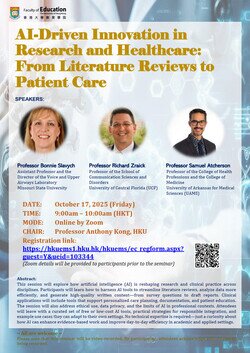
AI-Driven Innovation in Research and Healthcare: From Literature Reviews to Patient Care
Professor Bonnie Slavych
Assistant Professor and the Director of the Voice and Upper Airways Laboratory
Missouri State University
Professor Richard Zraick
Professor of the School of Communication Sciences and Disorders
University of Central Florida (UCF)
Professor Samuel Atcherson
Professor of the College of Health Professions and the College of Medicine
University of Arkansas for Medical Sciences (UAMS)
Date: October 17, 2025 (Friday)
Time: 9:00am – 10:00am (HKT)
Mode: Online by Zoom
Chair: Professor Anthony Kong, HKU
Abstract:
This session will explore how artificial intelligence (AI) is reshaping research and clinical practice across disciplines. Participants will learn how to harness AI tools to streamline literature reviews, analyze data more efficiently, and generate high-quality written content—from survey questions to draft reports. Clinical applications will include tools that support personalized care planning, documentation, and patient education. The session will also address ethical use, data privacy, and the limits of AI in professional contexts. Attendees will leave with a curated set of free or low-cost AI tools, practical strategies for responsible integration, and example use cases they can adapt to their own settings. No technical expertise is required—just a curiosity about how AI can enhance evidence-based work and improve day-to-day efficiency in academic and applied settings.
About the speakers:
Bonnie Slavych is an Assistant Professor and the Director of the Voice and Upper Airways Laboratory at Missouri State University. She holds a Certificate in Effective College Instruction from the Association of College and University Educators (ACUE), a nationally recognized program focused on evidence-based teaching practices in higher education. She earned both her Master’s and Ph.D. in Communication Sciences and Disorders from the University of Arkansas for Medical Sciences. Dr. Slavych teaches undergraduate and graduate courses in medical speech-language pathology and conducts research at the intersection of clinical and educational practice. She is the developer and leader of PD Speak, Swallow, Learn, a community-based education and support program for individuals with Parkinson’s disease, created in partnership with the Parkinson’s Group of the Ozarks. She has authored 15 peer-reviewed manuscripts in scientific journals and has delivered over 45 presentations at national and regional conferences. Her research focuses on three primary areas: (1) evaluation and treatment of voice disorders, (2) health communication, and (3) evidence-based course design and assessment in higher education.
Richard Zraick is a Professor and formerly the Founding Director of the School of Communication Sciences and Disorders at University of Central Florida (UCF). He is a Fellow of the American Speech, Language, and Hearing Association. He is also a Certified Health Simulation Educator. He received his undergraduate degree in Psychology from the University of Arizona, his Master’s degree in Speech and Hearing Science from the University of Arizona, and his Doctor of Philosophy degree from Arizona State University. Prior to joining the faculty at UCF, he was on the faculty at the University of Arkansas for Medical Sciences for 17 years and taught undergraduate and graduate courses in the area of medical speech-language pathology, supervised student-clinicians in the teaching hospital and conducted research. He has over 60 peer-reviewed manuscripts in scientific journals, has given over 100 presentations at scientific and professional conferences, and is co-author of the leading textbook on voice disorders, The Voice and Voice Therapy (now in its 11th edition). His research focuses on three primary areas: (1) evaluation and treatment of voice disorders, (2) healthcare simulation, and (3) health communication. He is a “clinician at heart” and has worked as a speech-language pathologist throughout his academic career, bringing decades of clinical experience into the classroom and clinic teaching environments.
Samuel R. Atcherson is a nationally recognized leader, scholar, and educator in audiology and a Distinguished Scholar Fellow of the National Academies of Practice (FNAP). He is a Professor at the University of Arkansas for Medical Sciences (UAMS) in both the College of Health Professions and the College of Medicine. He received in bachelors and masters degrees in communication sciences and disorders and audiology from the University of Georgia and his PhD in audiology and speech pathology from the University of Memphis. Dr Atcherson has authored over 60 peer-reviewed articles, over 50 non-refereed pieces, 16 invited chapters, 5 textbooks, and over 280 presentations or panels from local to international levels. His two most recent books are Auditory Electrophysiology: A Clinical Guide (2nd ed.) and Audiology: Diagnosis (3rd ed.) with Thieme Medical Publishers. As a person with lifelong hearing loss and a current cochlear implant user, his expertise spans many areas of audiology including audiologic rehabilitation, auditory and vestibular electrophysiology, and health literacy and disparities. Recent investigations involve studies involving screening of patients with neurofibromatosis and schwannomatosis; transparent facemasks and acoustic characteristics of electronic auscultation stethoscopes for deaf and hard of hearing health professionals; accessibility for Deaf sign language patients in audiology clinics; and generative AI in education. He is also concluding studies on the use of readability formulas and linguistic evaluations of patient-reported outcome measures.
~ All are welcome ~
Please note that this seminar will be video-recorded. By participating, attendees acknowledge and consent to being recorded.
You may also be interested in
- 25Oct
HKU Information Day for Undergraduate Admissions 2025
October 25, 2025 (Sat)
9:00 AM - 6:00 PM
Rayson Huang Theatre and Runme Shaw Building, HKUadmissions-talk, information-day
- 31Oct

Seminar: Back on Track: A Multi-Component Home-Based Program to Support Children with Dyslexia
October 31, 2025 (Fri)
12:45 PM - 2:00 PM
Professor Johannes Zieglerseminar
- 01Nov
Public Forum on Digital Education Policy in Hong Kong
Shaping the Future of Digital Education in Hong Kong: Navigating AI and InnovationNovember 01, 2025 (Sat)
2:00 PM - 4:00 PM
Multi-Purpose Area, 2/F, Main Library, HKUconference-forum-meeting