
AI-Mediated Language Learning: New Contexts, Experiences, and Possibilities
Seminar
Date
October 05, 2026 (Mon)
Venue
Time
2:30 PM - 5:00 PM
Speakers
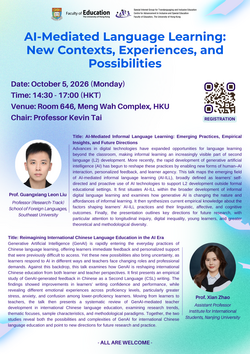
AI-Mediated Language Learning: New Contexts, Experiences, and Possibilities
Professor Guangxiang Leon Liu
School of Foreign Languages, Southeast University
Professor Xian Zhao
Institute for International Students, Nanjing University
Date: 5 October 2026 (Monday)
Venue: Room 646, Meng Wah Complex, HKU
Time: 2:30–5:00 p.m. (HKT)
Chair: Professor Kevin W. H. Tai
Talk 1
AI-Mediated Informal Language Learning: Emerging Practices, Empirical Insights, and Future Directions
Professor Guangxiang Leon Liu
Professor (Research-Track), School of Foreign Languages, Southeast University
Abstract:
Advances in digital technologies have expanded opportunities for language learning beyond the classroom, making informal learning an increasingly visible part of second language (L2) development. More recently, the rapid development of generative artificial intelligence (AI) has begun to reshape these practices by enabling new forms of human–AI interaction, personalized feedback, and learner agency. This talk maps the emerging field of AI-mediated informal language learning (AI-ILL), broadly defined as learners’ self-directed and proactive use of AI technologies to support L2 development outside formal educational settings. It first situates AI-ILL within the broader development of informal digital language learning and examines how generative AI is changing the nature and affordances of informal learning. It then synthesizes current empirical knowledge about the factors shaping learners’ AI-ILL practices and their linguistic, affective, and cognitive outcomes. Finally, the presentation outlines key directions for future research, with particular attention to longitudinal inquiry, digital inequality, young learners, and greater theoretical and methodological diversity.
Talk 2
Reimagining International Chinese Language Education in the AI Era
Professor Xian Zhao
Assistant Professor, Institute for International Students, Nanjing University
Abstract:
Generative Artificial Intelligence (GenAI) is rapidly entering the everyday practices of Chinese language learning, offering learners immediate feedback and personalized support that were previously difficult to access. Yet these new possibilities also bring uncertainty, as learners respond to AI in different ways and teachers face changing roles and professional demands. Against this backdrop, this talk examines how GenAI is reshaping international Chinese education from both learner and teacher perspectives. It first presents an empirical study of GenAI-generated feedback in Chinese as a Second Language (CSL) writing. The findings showed improvements in learners’ writing confidence and performance, while revealing different emotional experiences across proficiency levels, particularly greater stress, anxiety, and confusion among lower-proficiency learners. Moving from learners to teachers, the talk then presents a systematic review of GenAI-mediated teacher development in international Chinese language education, examining research trends, thematic focuses, sample characteristics, and methodological paradigms. Together, the two studies reveal both the possibilities and complexities of GenAI for international Chinese language education and point to new directions for future research and practice.
~ All are welcome ~
You may also be interested in
- 09Oct

Education Mentorship Programme – Sharing Session on “How to Prepare for a Teacher Interview”
October 09, 2026 (Fri)
7:30 PM - 9:00 PM
Room 754, 7/F, Meng Wah Complex, HKUsharing-session
- 14Oct

Seminar: The Affective and Neural Correlates of Mind Wandering
October 14, 2026 (Wed)
12:45 PM - 2:00 PM
Professor Julia Kamseminar
- 16Oct
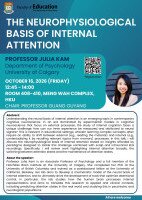
Seminar: The Neurophysiological Basis of Internal Attention
October 16, 2026 (Fri)
12:45 PM - 2:00 PM
Professor Julia Kamseminar