
Date
October 14, 2026 (Wed)
Venue
Time
12:45 PM - 2:00 PM
Speaker
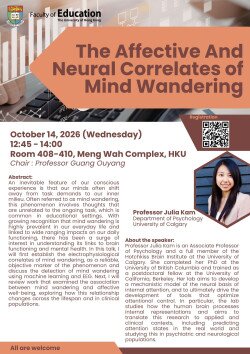
The Affective and Neural Correlates of Mind Wandering
Professor Julia Kam
University of Calgary
October 14, 2026 (Wednesday)
12:45 - 14:00
Room 408-410, Meng Wah Complex, HKU
Chair: Professor Guang Ouyang
Abstract:
An inevitable feature of our conscious experience is that our minds often shift away from task demands to our inner milieu. Often referred to as mind wandering, this phenomenon involves thoughts that are unrelated to the ongoing task, which is common in educational settings. With growing recognition that mind wandering is highly prevalent in our everyday life and linked to wide ranging impacts on our daily functioning, there has been a surge of interest in understanding its links to brain functioning and mental health. In this talk, I will first establish the electrophysiological correlates of mind wandering, as a reliable, objective marker of the phenomenon and discuss the detection of mind wandering using machine learning and EEG. Next, I will review work that examined the association between mind wandering and affective well-being, exploring how this relationship changes across the lifespan and in clinical populations
About the speaker:
Professor Julia Kam is an Associate Professor of Psychology and a full member of the Hotchkiss Brain Institute at the University of Calgary. She completed her PhD at the University of British Columbia and trained as a postdoctoral fellow at the University of California, Berkeley. Her lab aims to develop a mechanistic model of the neural basis of internal attention, and to ultimately drive the development of tools that optimize attentional control. In particular, the lab studies how the human brain processes internal representations and aims to translate this research to applied and clinical contexts, including predicting attention states in the real world and studying this in psychiatric and neurological populations.
All are welcome
You may also be interested in
- 16Oct
Seminar: The Neurophysiological Basis of Internal Attention
October 16, 2026 (Fri)
12:45 PM - 2:00 PM
Professor Julia Kamseminar
- 22Oct
Seminar: Exploring Context Through Actor-Network Theory: An STS Approach to Education Research
October 22, 2026 (Thu)
3:00 PM - 5:00 PM
Professor Nelli Piattoevaseminar
- 24Oct
HKU Information Day for Undergraduate Admissions 2026
October 24, 2026 (Sat)
9:00 AM - 6:00 PM
Rayson Huang Theatre and Runme Shaw Building, HKUadmissions-talk, information-day