
Pedagogy First: Rethinking Science Learning in the Age of AI
As GenAI is transforming education, questions about how it should be used in classrooms are increasingly important. For Professor Logan Chen, the focus is not on the technology itself, but on how it can support meaningful learning grounded in sound pedagogy.
GenAI has prompted a wave of experimentation in STEM education, offering tools that can generate lesson plans, support personalised learning, and simulate complex scientific phenomena. Yet, for Professor Logan Chen, Assistant Professor in the Faculty’s Academic Unit of Mathematics, Science, and Technology, the starting point is not the technology, but the learner.
“We do not begin by asking how AI works,” says Professor Chen. “We begin by asking how students’ minds work, what cognitive processes make understanding possible, and what pedagogies are best suited to particular learning objectives.”
This perspective shapes his teaching and curriculum design. Professor Chen and his team co-created an innovative pedagogy known as Amicus Aristotle, Latin for “Aristotle is my friend.” It is an approach grounded in theory, evidence, and classroom experience. In contrast to starting with technology, it focuses on long-standing questions about how students develop scientific understanding and what kinds of learning experiences best support that process.
Understanding Misconceptions
Under this approach, a simple question is posed to the students: where does the mass of a tree come from? Many students answer soil or water. Few identify the correct source – carbon dioxide from the air, converted through photosynthesis.
These responses, however, are not merely mistakes. They reflect patterns of reasoning that have appeared throughout the history of science. Aristotle reasoned that the soil must be the tree’s stomach, while centuries later, van Helmont concluded from his famous willow experiment that water alone was responsible for plant growth.
“Students who say that ‘the tree eats the soil’ are thinking like Aristotle,” Professor Chen remarks. “These are signs of genuine reasoning, even if the conclusions do not align with modern scientific understanding.”
One of the central challenges in science education is helping students address misconceptions – ideas that seem intuitive but are scientifically incorrect. Research in cognitive neuroscience suggests that such misconceptions are never fully erased. Instead, learners must develop the ability to recognise incorrect ideas and consciously set them aside – a cognitive process known as inhibition. However, inhibition is rarely taught explicitly in classrooms where the emphasis tends to be on building new knowledge and integrating perspectives, rather than helping students refine or reject existing ideas.
Designing Learning Around Inhibition
To respond to this need, Professor Chen and his team developed – well before the emergence of AI – a teaching design for junior secondary students, combining the history of scientific ideas, LEGO Serious Play, and structured debate.
Students take on the roles of historical figures such as Aristotle, Thales, Palissy, and van Helmont, building LEGO models representing each scientist’s theory and debating the validity of these explanations. Through this process, misconceptions are not only identified but also externalised and examined.
“Progress in science is not made by combining or balancing everyone’s ideas, but by rejecting hypotheses and shifting paradigms,” Professor Chen explains. “Students need to experience that process for themselves.”
The approach proved effective in helping students reflect on their ideas. Still, it had limitations. In particular, it was difficult to show how misconceptions were interconnected across different theories and scientific fields.
When AI Completes the Pedagogy
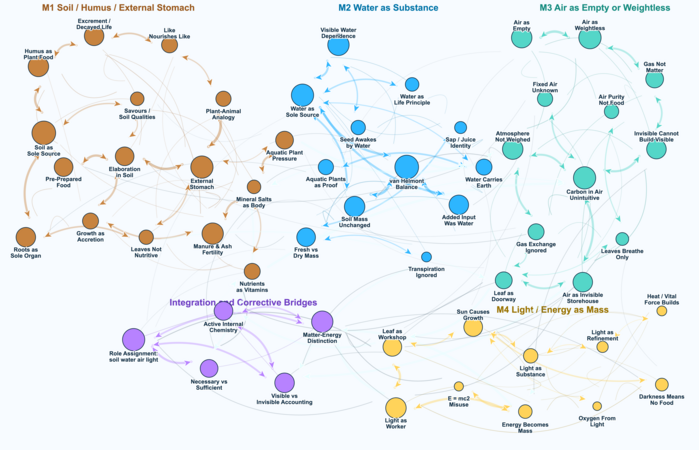
A misconception network that guides how the AI traverses the problem space. The AI scans, exhausts, and transits admidst the misconception network as it engages in discussion with students.
(Node Size = Variance; Thick Links = Main Weights; Thin Sold Links = Weak Probability Links)
The introduction of GenAI provided a way to address this limitation. Instead of replacing existing practices, AI was integrated to extend them.
The result is Amicus Aristotle AI (https://amicusaristotle.ai), an AI-empowered learning experience in which students engage in simulated conversations with historical scientists. Each AI persona has a biography, a theoretical framework, and a network of interconnected misconceptions.
“We had been looking for a way to make these connections visible through natural interaction,” says Professor Chen. “When AI became available, it allowed those missing links to emerge.”
Through these dialogues, students encounter multiple perspectives at once. Instead of examining a single idea in isolation, they are required to evaluate competing arguments and identify underlying assumptions.
Importantly, AI does not function in isolation. The curriculum still includes hands-on elements such as LEGO modelling and web-lab experiments, allowing students to test and refine their understanding across different modes of learning.

Professor Logan Chen (second from right) and Professor Kennedy Chan (first from right) with the science teachers from Fanling Kau Yan College during a professional development workshop. They are holding a LEGO model representing their theory of plant nutrition.
Collaborating with Teachers
The development of Amicus Aristotle AI involved close collaboration with educators. Professor Chen worked with the Faculty’s Professor Kennedy Chan and a team of science teachers from Fanling Kau Yan College to refine the approach to ensure that it aligned with classroom practice and curriculum requirements.
This collaboration shaped not only the design of the teaching materials, but also teachers’ own professional thinking. One teacher reported a shift from prioritising factual knowledge to exploring the evolution of ideas. Another reversed the teaching sequence to allow students to investigate concepts through inquiry rather than simply receiving knowledge through dictation.
As Professor Chen notes, this process highlights the importance of grounding innovation in classroom experience. Teachers’ insights helped ensure that the project remained practical, meaningful, and responsive to students’ needs.
Pedagogy Comes First
A consistent message runs through Professor Chen’s work: pedagogy should come before technology.
He describes this as a distinction between AI-centred and AI-empowered education. The pedagogy – rooted in inhibition theory, the history of science, and embodied learning – is developed first, with technology introduced only where it provides clear and demonstrable value.
“When teachers have spent years working on a genuine pedagogical challenge, they recognise the missing piece when it finally appears,” he reflects. “AI did not create the approach. It completed it.”
Pedagogy and Practice in an AI Era
As AI continues to evolve, its role in education is likely to expand. For Professor Chen, the key question is how it can be integrated in ways that support deeper understanding.
The Amicus Aristotle AI project offers one example of how this can be achieved: by combining established pedagogical principles with new technological possibilities, and by grounding innovation in both research and practice.
“We are all built from the LEGO bricks of those who came before us,” Professor Chen comments. “The challenge is to know which bricks belong and which must be set aside.”
In this sense, the role of education remains consistent, even as tools evolve. As Professor Chen’s work shows, helping students question, refine, and rethink their understanding prepares them not only to learn from the past, but also to engage critically with the knowledge and technologies of the future.
.jpg)
Professor Logan Chen
Assistant Professor
Academic Unit of Mathematics, Science, and Technology