
Seminar: Re-thinking spatial justice: From territorial stigmatisation to spatially inclusive public policy
Seminar
Date
October 30, 2026 (Fri)
Venue
Time
2:30 PM - 3:45 PM
Speaker
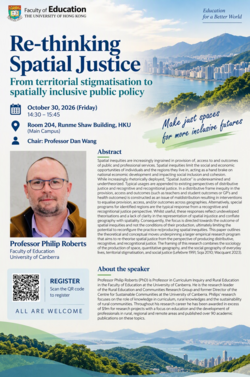
Re-thinking spatial justice: From territorial stigmatisation to spatially inclusive public policy
Professor Philip Roberts
Faculty of Education, University of Canberra
October 30, 2026 (Friday)
14:30 – 15:45
Room 204, Runme Shaw Building, HKU
Chair: Professor Dan Wang
Abstract:
Spatial inequities are increasingly ingrained in provision of, access to and outcomes of public and professional services. Spatial inequities limit the social and economic opportunities of individuals and the regions they live in, acting as a hand brake on national economic development and impacting social inclusion and cohesion. While increasingly rhetorically deployed, “Spatial Justice” is underexamined and undertheorized. Typical usages are appended to existing perspectives of distributive justice and recognitive and recognitional justice. In a distributive frame inequity in the provision, access and outcomes (such as teachers and student outcomes or GP’s and health outcomes) is constructed as an issue of maldistribution resulting in interventions to equalise provision, access, and/or outcomes across geographies. Alternatively, special programs for identified regions are the typical response from a recognitive and recognitional justice perspective. Whilst useful, these responses reflect undeveloped theorisations and a lack of clarity in the representation of spatial injustice and conflate geography with spatiality. Consequently, the focus is directed towards the outcome of spatial inequities and not the conditions of their production, ultimately limiting the potential to reconfigure the practice re/producing spatial inequities. This paper outlines the theoretical and conceptual moves underpinning a larger empirical research program that aims to re-theorise spatial justice from the perspective of producing distributive, recognitive, and recognitional justice. The framing of this research combines the sociology of the production of space, quantitative geography, and the social geography of everyday lives, territorial stigmatisation, and social justice (Lefebvre 1991; Soja 2010; Wacquant 2023).
About the speaker:
Professor Philip Roberts (PhD) is Professor in Curriculum Inquiry and Rural Education in the Faculty of Education at the University of Canberra. He is the research leader of the Rural Education and Communities Research Group and former Director of the Centre for Sustainable Communities at the University of Canberra. Philips’ research focuses on the role of knowledge in curriculum, rural knowledges and the sustainability of rural communities. Throughout his research career he has been awarded in excess of $9m for research projects with a focus on education and the development of professionals in rural, regional and remote areas and published over 90 academic publications on these topics.
~ All are welcome ~
You may also be interested in
- From07NovTo08Nov
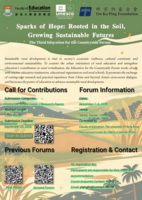
The Third Education for the Countryside Forum -
Sparks of Hope: Rooted in the Soil, Growing Sustainable FuturesNovember 07 - 08, 2026 (Sat-Sun)
Sanya, Hainanconference-forum-meeting