
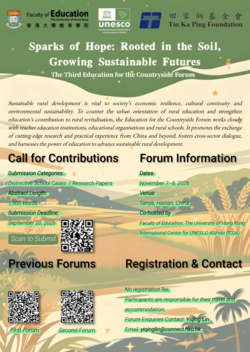
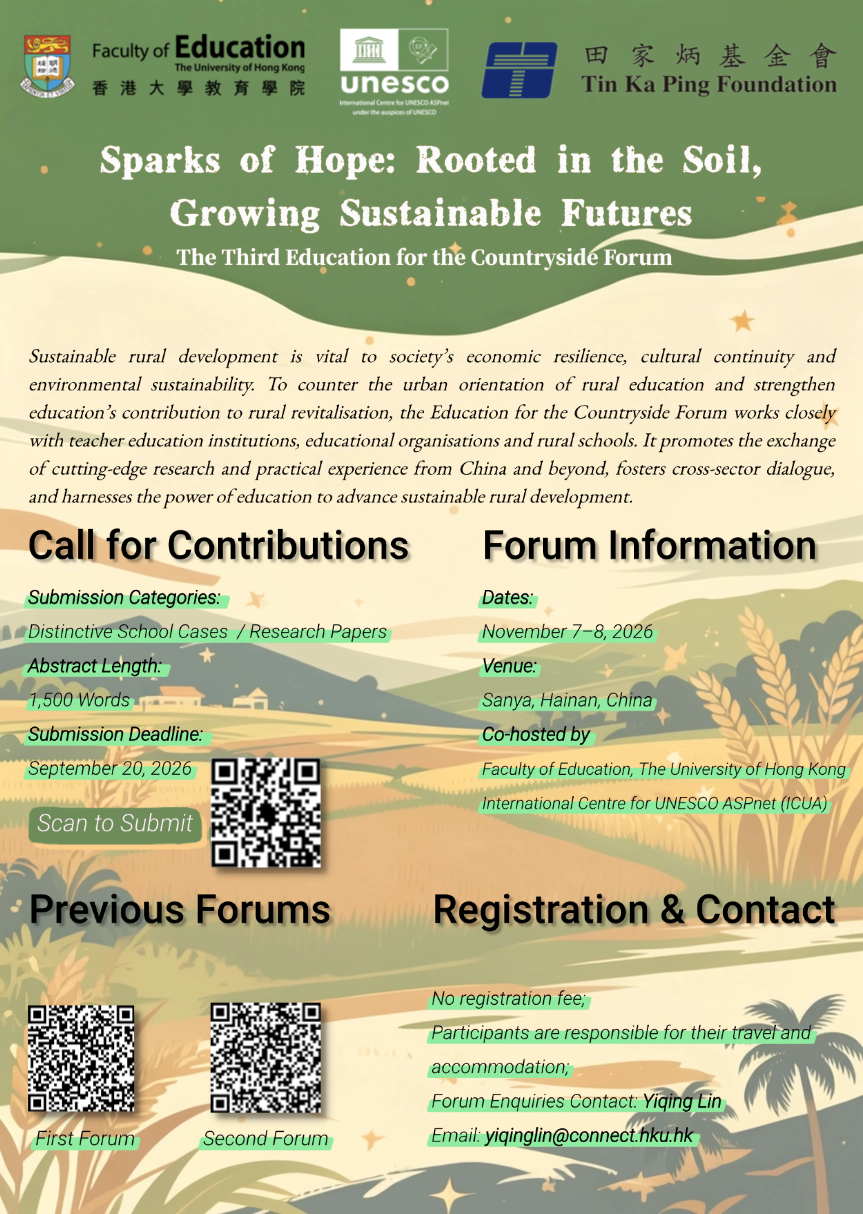
The Third Education for the Countryside Forum -
Sparks of Hope: Rooted in the Soil, Growing Sustainable Futures
Conference/Forum/Meeting
Date
November 07 - 08, 2026 (Sat-Sun)
Venue
Background
The world today is shaped by two contrasting realities. While cities continue to thrive through the increasing concentration of talent, capital, and opportunities, many rural communities face population decline, economic contraction, and social fragmentation, raising concerns about their long-term sustainability. Modern education systems have largely been oriented toward urban life and employment, promoting the notion of “learning to leave the countryside” and further deepening rural-urban inequalities.
Yet rural areas remain central to humanity’s future. Home to nearly half of the world’s population and a substantial share of the global workforce, rural communities sustain food systems, steward natural resources, preserve cultural heritage, and nurture diverse forms of local knowledge. Revitalizing rural communities and agriculture is therefore not only a matter of rural development, but also a pathway toward greater economic resilience, cultural continuity, and ecological sustainability. Rural sustainable development directly links to multiple UN 2030 Agenda targets: No Poverty (SDG 1), Zero Hunger (SDG 2), Quality Education (SDG 4), Decent Work and Economic Growth (SDG 8), Sustainable Cities and Communities (SDG 11), Responsible Consumption and Production (SDG 12), Climate Action (SDG 13), Life on Land (SDG 15), and Life Below Water (SDG 14).
The pursuit of rural sustainability calls for a reorientation of the mission and content of education. UNESCO’s Education for Sustainable Development (ESD) for 2030 roadmap advocates empowering learners as change agents with knowledge, skills, values, and attitudes to address global challenges. Rather than simply preparing young people for urban life and upward mobility, education must embrace a broader responsibility: connecting learning with rural development, agricultural innovation, and community sustainability. Schools should empower learners to understand, engage with, and contribute to rural communities, cultivating both the capacities and the commitment needed to build thriving futures.
Education is not only about shaping individuals. By shaping individuals, it also shapes the future of rural communities and, ultimately, the future of society as a whole.
The Education for the Countryside Forum
It is against the backdrop of growing rural-urban divides that the Education for the Countryside Forum was launched. Initiated by the Faculty of Education at The University of Hong Kong with the support of the Tin Ka Ping Foundation, the Forum seeks to reorient education beyond its urban focus, promote rural revitalization and sustainable development, and explore pathways to realizing UNESCO’s vision of “transforming our world through education.”
The Third Forum is jointly organized with the International Centre for UNESCO ASPnet (ICUA). ICUA coordinates UNESCO ASPnet, a network of over 10,000 schools across 170+ countries advancing peace, sustainable development, and international understanding through transformative education. ASPnet members contribute rich experience in ESD, intercultural and heritage learning, and community-based learning, offering diverse international perspectives and innovative cases.
The Forum will bring together educational scholars, ASPnet members, community leaders, policymakers, entrepreneurs, and school practitioners to share and reflect on the philosophies and practices of “Education for the Countryside.” The Forum seeks to create a platform for showcasing innovative grassroots initiatives from around the world, making local experiences more visible and fostering dialogue across diverse contexts. In doing so, it aims to inspire new thinking and collective action towards transforming rural education in support of the Sustainable Development Goals (SDGs).
Key Themes
The Forum focuses on the role of education in advancing the Sustainable Development Goals (SDGs), with particular emphasis on:
- Rural Cultures, Heritage, and Innovation
- Sustainable Agriculture and Ecological Futures
- Community Vitality and Rural Development
- Global Perspectives and Local Practices
Who should Participate
The forum features keynote speeches, thematic panels, principal dialogues, and roundtable discussions. We invite:
- Researchers in rural education and sustainable development
- Policymakers and educational administrators
- Rural school practitioners and UNESCO ASPnet members
- Community workers, cultural heritage practitioners, and NGO representatives
- Stakeholders interested in rural education and sustainable development
We especially welcome rural school practitioners, UNESCO ASPnet National Coordinators and member schools to share innovative practices rooted in local communities and cultures.
Forum Agenda
Date | Time | Programme |
|---|---|---|
November 6 (Friday) | All day | Participant Registration |
November 7 (Saturday) | Morning | Opening Ceremony and keynote Address |
| Afternoon | Principals’ Dialogue and Roundtable Discussions | |
| Evening | Film Screening (By Invitation) | |
November 8 (Sunday) | Morning | Parallel Sessions and Thematic Panels |
| Afternoon | Roundtable Discussions and Closing |
Call for Contributions
We welcome research papers, practice-based studies, and innovative school and community cases related to the Forum themes. Abstracts (maximum 1,500 words, excluding references) or full papers may be submitted via: https://www.wjx.top/vm/PAGgHnr.aspx#
Submission Deadline: September 20, 2026
Conference Fees
No registration fee. Participants cover their own travel and accommodation costs.
Co-hosted by
- Faculty of Education, The University of Hong Kong
- International Centre for UNESCO ASPnet (ICUA)
Sponsored by
Tin Ka Ping Foundation
Forum Inquiries
Contact Person: Lin Yiqing
Email: [javascript protected email address]
Click here to view all forums in the "Education for the Countryside" Series.