
Human Learning in the AI Era: Cognitive Load, Embodied Cognition, and Language Education
Seminar
Date
May 27, 2026 (Wed)
Venue
Time
3:00 PM - 5:00 PM
Speaker
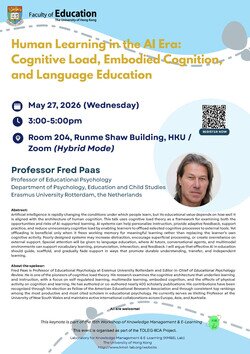
Human Learning in the AI Era: Cognitive Load, Embodied Cognition, and Language Education
Professor Fred Paas
Professor of Educational Psychology
Department of Psychology, Education and Child Studies
Erasmus University Rotterdam, the Netherlands
May 27, 2026 (Wednesday)
3:00 - 5:00pm
Room 204, Runme Shaw Building, HKU / by Zoom (Hybrid Mode)
Abstract:
Artificial intelligence is rapidly changing the conditions under which people learn, but its educational value depends on how well it is aligned with the architecture of human cognition. This talk uses cognitive load theory as a framework for examining both the opportunities and risks of AI-supported learning. AI systems can help personalize instruction, provide adaptive feedback, support practice, and reduce unnecessary cognitive load by enabling learners to offload selected cognitive processes to external tools. Yet offloading is beneficial only when it frees working memory for meaningful learning rather than replacing the learner’s own cognitive activity. Poorly designed systems may increase distraction, encourage superficial processing, or create overreliance on external support. Special attention will be given to language education, where AI tutors, conversational agents, and multimodal environments can support vocabulary learning, pronunciation, interaction, and feedback. I will argue that effective AI in education should guide, scaffold, and gradually fade support in ways that promote durable understanding, transfer, and independent learning.
About the speaker:
Fred Paas is Professor of Educational Psychology at Erasmus University Rotterdam and Editor-in-Chief of Educational Psychology Review. He is one of the pioneers of cognitive load theory. His research examines the cognitive architecture that underlies learning and instruction, with a focus on self-regulated learning, multimedia learning, embodied cognition, and the effects of physical activity on cognition and learning. He has authored or co-authored nearly 400 scholarly publications. His contributions have been recognized through his election as Fellow of the American Educational Research Association and through consistent top rankings among the most productive and most cited scholars in educational psychology. He currently serves as Visiting Professor at the University of New South Wales and maintains active international collaborations across Europe, Asia, and Australia.
~ All are welcome ~
[This keynote is part of the 15th Workshop of Knowledge Management & E-Learning]
[This event is organised as part of the TDLEG-IICA Project]
You may also be interested in
- 01Jun
Covariation of Reading and Mathematical Development: A Longitudinal and Cross-Cultural Perspective
June 01, 2026 (Mon)
12:45 PM - 2:00 PM
Professor Yang Xiujieseminar
- 03Jun
Comorbidity of Dyslexia and Dyscalculia: Cognitive-Neural Mechanisms and Interventions
June 03, 2026 (Wed)
12:45 PM - 2:00 PM
Professor Yang Xiujieseminar
- 10Jun
Integrating Theoretical Perspectives: Whether and How Music Training Improves Chinese Word Reading
June 10, 2026 (Wed)
3:00 PM - 4:15 PM
Professor William Choiseminar