
[CHERA Seminar] National Policies and Transnational Initiatives in Higher Education in India
Seminar
Date
November 17, 2026 (Tue)
Format
Time
4:30 PM - 5:45 PM
Speaker

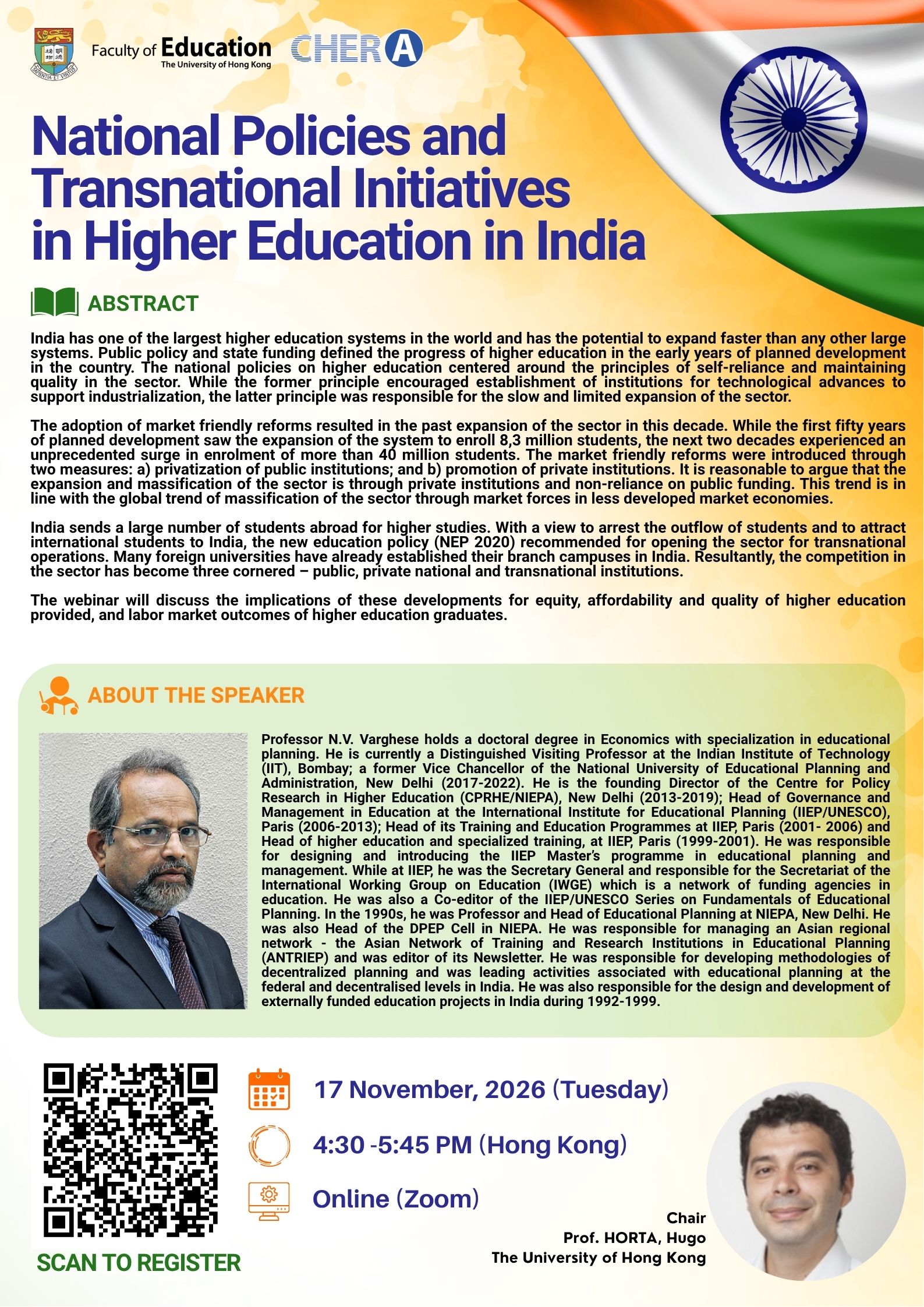
National Policies and Transnational Initiatives in Higher Education in India
Date: November 17, 2026 (Thuessday)
Time: 4:30 pm - 5:45 pm
Format: Online via Zoom
Language: English
Registration: https://hku.zoom.us/meeting/register/kZhznRDWSH6_bmY3cSc9bw#/registration
India has one of the largest higher education systems in the world and has the potential to expand faster than any other large systems. Public policy and state funding defined the progress of higher education in the early years of planned development in the country. The national policies on higher education centered around the principles of self-reliance and maintaining quality in the sector. While the former principle encouraged establishment of institutions for technological advances to support industrialization, the latter principle was responsible for the slow and limited expansion of the sector.
The adoption of market friendly reforms resulted in the past expansion of the sector in this decade. While the first fifty years of planned development saw the expansion of the system to enroll 8,3 million students, the next two decades experienced an unprecedented surge in enrolment of more than 40 million students. The market friendly reforms were introduced through two measures: a) privatization of public institutions; and b) promotion of private institutions. It is reasonable to argue that the expansion and massification of the sector is through private institutions and non-reliance on public funding. This trend is in line with the global trend of massification of the sector through market forces in less developed market economies.
India sends a large number of students abroad for higher studies. With a view to arrest the outflow of students and to attract international students to India, the new education policy (NEP 2020) recommended for opening the sector for transnational operations. Many foreign universities have already established their branch campuses in India. Resultantly, the competition in the sector has become three cornered – public, private national and transnational institutions.
The webinar will discuss the implications of these developments for equity, affordability and quality of higher education provided, and labor market outcomes of higher education graduates.
About the Speaker:
Professor N.V. Varghese holds a doctoral degree in Economics with specialization in educational planning. He is currently a Distinguished Visiting Professor at the Indian Institute of Technology (IIT), Bombay; a former Vice Chancellor of the National University of Educational Planning and Administration, New Delhi (2017-2022). He is the founding Director of the Centre for Policy Research in Higher Education (CPRHE/NIEPA), New Delhi (2013-2019); Head of Governance and Management in Education at the International Institute for Educational Planning (IIEP/UNESCO), Paris (2006-2013); Head of its Training and Education Programmes at IIEP, Paris (2001- 2006) and Head of higher education and specialized training, at IIEP, Paris (1999-2001). He was responsible for designing and introducing the IIEP Master’s programme in educational planning and management. While at IIEP, he was the Secretary General and responsible for the Secretariat of the International Working Group on Education (IWGE) which is a network of funding agencies in education. He was also a Co-editor of the IIEP/UNESCO Series on Fundamentals of Educational Planning. In the 1990s, he was Professor and Head of Educational Planning at NIEPA, New Delhi. He was also Head of the DPEP Cell in NIEPA. He was responsible for managing an Asian regional network - the Asian Network of Training and Research Institutions in Educational Planning (ANTRIEP) and was editor of its Newsletter. He was responsible for developing methodologies of decentralized planning and was leading activities associated with educational planning at the federal and decentralised levels in India. He was also responsible for the design and development of externally funded education projects in India during 1992-1999.
All are welcome!
Enquiries: [javascript protected email address]
You may also be interested in
- 26Nov

CHERA Seminar: Internationalization and Geopolitics in Global Higher Education
November 26, 2026 (Thu)
1:30 PM - 3:00 PM
Professor Philip G. Altbach,
Professor Hans de Wit,
Professor Gerard A. Postiglione,
Professor Rui Yangseminar
- 02Dec
Research Seminar: Research Integrity and Artificial Intelligence: Preparing for the Worst
December 02, 2026 (Wed)
12:45 PM - 2:00 PM
Professor David I. Waddington
seminar