
Knowledge Exchange in Action:
Turning Research into Shared Understanding

Professor Karen Chan (sixth from left, back row) at the Care for You – Carefood Project results announcement in January 2026.
By translating research on swallowing safety and food risk into everyday practice, Professor Karen Chan’s work demonstrates how research can support safer care within the community. Her approach focuses on making knowledge accessible, practical, and relevant to daily life.
Swallowing safety is widely discussed, but not always clearly understood. In Hong Kong, questions about what is “safe to eat” are often shaped by fragmented information and uncertainty, particularly for older adults or individuals with medical conditions. This highlights a broader challenge: research can have greater impact when it is translated into clear, practical knowledge that people can understand and use with confidence.
Addressing this challenge is central to the work of Professor Karen Chan, Associate Professor in the Faculty’s Academic Unit of Human Communication, Learning, and Development and Director of the Swallowing Research Laboratory. Her work, recognised with the University’s Knowledge Exchange Excellence Award in 2025, is built on long-term partnerships with care homes, food providers, social service organisations, and community stakeholders. Through these collaborations, her research has moved beyond the University and into real-life practice.
Starting from the Ground
Professor Chan’s knowledge exchange (KE) efforts are rooted in close engagement with those directly affected. Over the years, she has encountered older adults struggling to eat safely, caregivers unsure how to prepare appropriate meals, and frontline staff working under pressure with limited training.
“When the late Professor Edwin Yiu and I completed a public policy project in 2015, we realised that there was a clear gap in services and knowledge around swallowing management for older adults,” she recalls. “That is when we started focusing more of our research and community projects on nursing homes.”
This early insight shaped Professor Chan’s approach. Although scientific knowledge on swallowing safety already existed, it was not always accessible in forms that supported everyday decision-making. Practices varied across care settings, and guidance could be difficult to interpret. These challenges pointed to the need for clearer and more usable ways of sharing research-based information.
From Research to Practice
These principles are reflected in Professor Chan’s Care for You – Carefood Project. Funded by the HKEX Foundation, this project focuses on swallowing safety among older adults and individuals with medical conditions. Swallowing difficulties are common but often misunderstood, and inconsistent food texture can pose risks during daily meals.
A key aspect of the project has been Professor Chan’s leadership in supporting the development of the Hong Kong Care Food Standards. Drawing on the International Dysphagia Diet Standardisation Initiative (IDDSI), her team worked with local partners to adapt the framework into a standardised and scientifically validated approach for local care settings. Building on its local adoption, this work has also contributed to the development of Greater Bay Area standards for dysphagia diets, supporting cross-boundary alignment.
The IDDSI framework was translated into Traditional Chinese and published on the IDDSI global website, extending its use among Chinese-speaking communities worldwide. Together with the team’s research data, these resources informed the Care Food Standards developed by the Hong Kong Council of Social Service and have supported adoption both locally and internationally.
Instead of producing technical guidelines alone, the project aimed to make evidence applicable in practice. Professor Chan observed that caregivers and care-home staff might lack structured training and sufficient knowledge about swallowing difficulties and safe dysphagia management. Recognising this gap, training became an important part of the project’s implementation. Caregivers were supported in understanding how food texture and drink thickness relate to swallowing safety, as well as in identifying potential risks in daily routines.
The project also involved collaboration with industry partners to develop ready-to-eat care food options. These products help reduce preparation pressures while maintaining safety and nutritional value, making them convenient and suitable for both care settings and families.
Over time, the impact of this work became visible. “I was very happy to see residents smiling and able to feed themselves while trying the care food products,” Professor Chan reflects. “With the right support and environment, mealtimes can be an enjoyable experience, rather than just a task to complete.”
Working Across Sectors
Implementing these changes required coordination across sectors, including care homes, service providers, and the food industry. Each group operates within its own constraints, making collaboration both complex and necessary.
“Different stakeholders have different priorities and restrictions,” Professor Chan notes. “Ensuring that research-based standards can be adopted in practice often requires considerable resources and coordination.” She adds that strong collective support has been vital. “I am very thankful that we have received great support from the Government, philanthropists, community partners, and industry partners in overcoming such challenges.”
Her work has shown that sustained partnerships are essential to effective knowledge exchange. By working closely with practitioners and organisations over time, it becomes possible to align expectations, adapt solutions, and build shared practices.
Communicating Food Risk Beyond Care Settings
Beyond swallowing safety, Professor Chan also focuses on how food-related risks are communicated to the public. Rather than presenting technical information, she emphasises clarity, relatability, and practical understanding. “Using everyday examples and hands-on activities helps people understand the concepts and apply them in their own situations,” she explains.
Public engagement has also helped reveal changes in awareness. During events such as the Gerontech and Innovation Expo, Professor Chan noted growing interest in swallowing management and care food among both the general public and the elderly service sector. This shift has encouraged her to expand her community-focused work.
Knowledge Exchange as a Continuing Journey
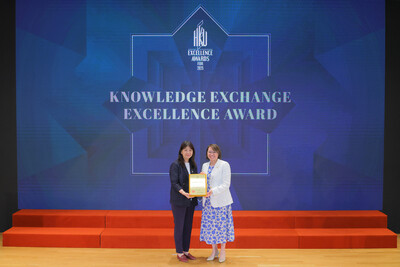
Professor Karen Chan (right) receives the Knowledge Exchange Excellence Award at the HKU Excellence Awards Presentation Ceremony for 2025.
In 2025, Professor Chan received the University’s Knowledge Exchange Excellence Award in recognition of the reach and impact of the Carefood Project. She views this as a shared achievement. “I am grateful to work with partners across different sectors who share the same mission and passion,” she says. “The support from my team has also been crucial in creating this impact in the community.”
Looking ahead, Professor Chan’s work will continue to extend the reach of knowledge into day-to-day contexts. This includes developing more accessible resources, strengthening interdisciplinary collaboration across sectors, and contributing to initiatives in the Greater Bay Area.
She also sees education as a key part of this effort. For Professor Chan, empowering communities is not simply about providing information, but about building understanding and confidence.
“Knowledge is power,” she emphasises. “By equipping the community with better knowledge of swallowing difficulties and management, we can improve the wellbeing of individuals with dysphagia and their caregivers.”
Her future KE initiatives will continue to build on this approach, combining research, education, and community engagement to address identified needs. As awareness grows and practices evolve, the aim is to support more consistent and informed decision-making across care settings and the wider community.
At its core, Professor Chan’s work reflects a clear direction: connecting research with lived experience, and ensuring that evidence can support choices in meaningful and sustainable ways.
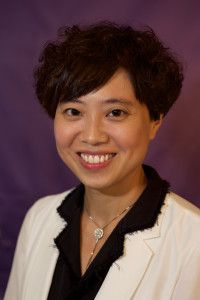
Professor Karen Chan
Associate Professor
Academic Unit of Human Communication, Learning, and Development