
Intercultural research capability in the age of gen AI: Preparing PhD graduates for transcultural knowledge co-construction
Seminar
Date
January 29, 2026 (Thu)
Mode
Time
4:00 PM - 5:30 PM
Speaker


Intercultural research capability in the age of gen AI: Preparing PhD graduates for transcultural knowledge co-construction
Speaker:
Professor Jing Qi
School of Global, Urban and Social Studies
RMIT University
Melbourne
Chair:
Professor Hugo Horta
Faculty of Education
The University of Hong Kong
Date: January 29, 2026 (Thursday)
Time: 4:00 pm - 5:30 pm
Mode: Online via Zoom
Language: English
Registration: https://hku.zoom.us/meeting/register/uZLAyzFLRCOcf6DrUNxd2g
This paper addresses two research questions: How relevant are PhD graduates’ multilingual and intercultural research capabilities to their research career? How can gen AI be used ethically and responsibly to enhance PhD graduates’ multilingual and intercultural research capabilities? I first introduce two theoretical framings that provide evidence-based justification for legitimising non-Western, non-English research and theorising. I then foreground three critical junctures where researchers could focus their energy on actions of significance when researching multilingually and interculturally, and explain how Gen AI can help at these critical junctures.
About the Speaker
Associate Professor Jing Qi is based in the School of Global, Urban and Social Studies at RMIT University, Melbourne. Jing’s research is broadly concerned with internationalisation of education. She draws together experiences in multilingual, intercultural, sociological and technological studies to bring an interdisciplinary perspective to education and community research. Jing publishes in areas including international/transnational education, doctoral education, teacher education, blended and digital learning, and language education.
All are welcome!
You may also be interested in
- 03Feb
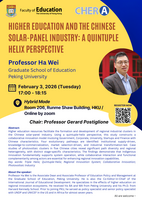
Seminar: Higher Education and the Chinese Solar-Panel Industry: A Quintuple Helix Perspective
February 03, 2026 (Tue)
5:00 PM - 6:15 PM
Professor Ha Weiseminar
- 04Feb

Seminar: Research Integrity and Research Impact: Reflecting on ‘participatory’ research with teachers
February 04, 2026 (Wed)
4:00 PM - 5:30 PM
Professor Karen Pashbyseminar
- 24Feb
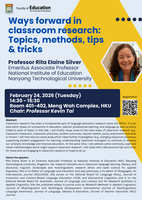
Seminar: Ways forward in classroom research: Topics, methods, tips & tricks
February 24, 2026 (Tue)
2:30 PM - 3:30 PM
Professor Rita Elaine Silverseminar